Is Cocomelon Overstimulating? What Parents Need to Know About the Popular Show
Real signs your toddler is overstimulated by Cocomelon (not just hyperactivity). Expert-backed checklist + what to do if your child crashes after watching.
Introduction
Does your toddler watch Cocomelon? You are not alone. It is one of the most recognized preschool brands on YouTube and streaming platforms, and many parents use it when they need a short break, a smoother transition, or a familiar routine that keeps kids engaged. The concern is not whether Cocomelon is popular. The real concern is whether the way it is produced feels too intense for your specific child.
Overstimulation happens when a child receives more sensory input than their developing brain can process comfortably in real time. In practice, this can look like post-screen meltdowns, bedtime resistance, or sudden hyperactivity after a short episode. But is Cocomelon actually overstimulating? The answer is more nuanced than a simple yes or no. Children respond differently based on age, temperament, sensory profile, timing, and viewing duration.
In this guide, we break down what makes some kids' content feel intense, the signs to watch for, and what to do if your child seems dysregulated. KidOK helps parents understand which content is right for their children, and this article gives you the framework to make those decisions with more confidence.
What Is Cocomelon?
Cocomelon is a children's entertainment brand that began on YouTube and expanded to major streaming platforms. It is built around nursery rhymes, simple social scenarios, family routines, and repetitive musical patterns that are easy for toddlers to follow. Episodes typically focus on everyday topics such as brushing teeth, sharing, bedtime routines, and basic early-learning concepts.
Parents choose Cocomelon for understandable reasons. It is predictable, children recognize the songs quickly, and it can hold attention when families need a practical screen-time option. The target audience is usually children ages 0 to 5, although older toddlers often keep watching if the format is familiar. Its style is intentionally high-engagement: bright colors, frequent movement, and layered audio cues that reduce quiet gaps. The brand has well over 150 million YouTube subscribers and has repeatedly appeared in top streaming kids lists, which explains why this question matters for so many families.
None of this automatically makes the show harmful. The key question is whether this high-engagement style matches your child's regulation needs. A show can be educational in topic and still be too intense in delivery for some children.
What Age Is Cocomelon Best For? Age-by-Age Breakdown
Cocomelon's target age range is broad, but Cocomelon age fit is not the same for every child. Overstimulation risk is usually highest in infants and younger toddlers, then becomes more manageable as executive function, language, and emotional regulation develop. If you are asking about the best age for Cocomelon, focus less on one universal number and more on your child's response pattern.
Ages 0-12 Months: Not Recommended
For infants, high-intensity screen content is usually not a good fit. Babies in this window do not benefit much from rapid narrative media, and the sensory load can feel overwhelming. AAP guidance recommends avoiding routine screen media for children under 18 months except video chatting. For this stage, singing, talking, face-to-face play, and simple sensory routines are better for infant development than fast animated content.
Ages 12-24 Months: Use with Extreme Caution
This is often the most sensitive Cocomelon age window. Toddlers between 12 and 24 months are still learning to regulate arousal and transitions. If you choose to use Cocomelon, keep sessions short and supervised, then watch for red flags like harder transitions, hyperactivity, sleep disruption, or post-screen meltdowns. Many families do better with 5 to 10 minutes max and a calm follow-up activity.
Ages 2-3 Years: Manageable in Small Doses
For many children in this toddler stage, Cocomelon can be manageable if exposure is structured. A common practical target is 15 to 20 minutes, ideally earlier in the day. Co-viewing helps because pausing to name emotions or actions gives the brain more processing time. If your 2-year-old or 3-year-old shows dysregulation, switch to a slower preschool option and compare behavior for two weeks.
For a practical screening checklist, read how to identify overstimulation in your child.
Ages 3-5 Years: Generally More Tolerant
Preschool children often tolerate more stimulation than younger toddlers, but sensitivity still varies widely. Some 4-year-olds can watch for 25 to 30 minutes with no obvious issues, while others show irritability after 10 to 15 minutes. The best approach is to track sleep, transitions, and emotional recovery, then set a limit based on your child's actual pattern.
Ages 5+: Usually Outgrowing Cocomelon
By age 5 and up, most children naturally move toward richer stories and slower, more complex narratives. Occasional Cocomelon viewing is usually fine, but many children in this age range prefer alternatives that better match school-age interests and attention development.
Key takeaway: age is important, but it is not the only factor. Temperament, sensory profile, timing, and duration can matter just as much as the listed Cocomelon age range.
What Is Overstimulation?
Overstimulation is a sensory overload state in which a child takes in more visual, auditory, and emotional input than they can regulate at that moment. Young children are especially vulnerable because attention filtering, impulse control, and emotional self-regulation are still developing. The same content can feel manageable one day and overwhelming the next depending on sleep, hunger, illness, transitions, or stress.
Signs can include higher activity levels, irritability, whining, reduced frustration tolerance, emotional outbursts, and trouble settling into quiet play. Sleep is often the first area parents notice, especially when high-arousal content is viewed close to bedtime. Effects can pass quickly in some children and linger for several hours in others. Repeated overstimulation over time may contribute to attention strain, bedtime resistance, and tougher daily transitions.
Pediatric guidance supports a quality-first approach rather than an all-or-nothing rule. The American Academy of Pediatrics recommends prioritizing high-quality programming, co-viewing when possible, and limiting media in early childhood, especially near sleep windows. If you want a deeper checklist, Learn more about the signs of overstimulation.
- Common duration: 15 minutes to several hours, depending on the child
- Immediate signs: restlessness, whining, hard transitions
- Delayed signs: bedtime delays, fragmented sleep, emotional crashes
- Long-term pattern risk: reduced tolerance for calm activities
What Do Experts Say About Cocomelon?
Pediatricians and child development experts increasingly treat overstimulation as a real regulation issue, not just a parenting trend. Cocomelon is not automatically harmful, but its combination of rapid pacing, bright visuals, and layered audio can exceed some children's sensory capacity, especially in toddlers and sensory-sensitive kids.
The American Academy of Pediatrics emphasizes that "quality matters more than quantity" in children's media use. That expert guidance helps frame the Cocomelon question correctly: parents are not deciding only how long a child watches, but also how intense the sensory delivery is. Research on fast-paced programming and executive function gives additional context for why some children appear wired after high-intensity content, then crash once it ends.
In short, concern about Cocomelon overstimulation is not just parental anxiety. It is an expert-backed child development question about match: does this media style fit your child's current regulation skills?
How Overstimulation Affects Brain Development
Executive Function
The clearest direct evidence comes from a randomized study in Pediatrics. Preschoolers who watched a fast-paced cartoon showed lower immediate executive function performance than peers who watched slower educational content or drew. Executive function includes planning, impulse control, working memory, and flexible thinking. These skills are central to school readiness and daily self-regulation.
Attention Regulation
Repeated exposure to high-intensity media can make slower real-world activities feel less rewarding. Parents often notice this as less patience for books, more restlessness during meals, and faster frustration during quiet play. This is not permanent damage, but it reflects how attention systems adapt to the pace they consume most often.
Stress Response and Cortisol
Physiologic studies suggest media format can influence stress biology in young children, including salivary cortisol response patterns after video viewing. That does not prove long-term harm from one show, but it does support the concern that high-intensity input can activate stress systems in vulnerable children. See our review of research on video viewing and child development.
Sleep Architecture
Overstimulation close to bedtime can delay sleep onset and fragment sleep quality. Sleep is when children consolidate memory, regulate emotions, and strengthen neural pathways. When high-intensity content disrupts that window, daytime behavior usually worsens first: more irritability, harder transitions, and lower frustration tolerance.
The Bottom Line
The concern is not that Cocomelon causes irreversible brain damage. The concern is that repeated overstimulation can delay development of self-regulation habits children need for learning and emotional stability. Practical steps matter more than fear: lower intensity, shorter sessions, better timing, and consistent observation of your child's response.
Why Cocomelon Can Be Overstimulating
Fast Animation and Rapid Cuts
Cocomelon is commonly estimated to change scenes every 1 to 3 seconds, which is substantially faster than many lower-intensity preschool shows. For comparison:
- Cocomelon: 1-3 second scene changes
- Daniel Tiger's Neighborhood: 8-15 second scene changes
- Bluey: 10-20 second scene changes
- Sesame Street: 5-10 second scene changes
These scene-change ranges vary by episode and by measurement method, but the relative pacing gap is consistent across most comparisons.
When content moves faster than a toddler can integrate, they can leave the screen in a heightened arousal state rather than a settled one. This rapid-fire pacing is designed to hold attention, but for sensory-sensitive children it can feel like overload. Randomized research in Pediatrics supports the broader concern: even short exposure to fast-paced children's content can reduce immediate executive function performance compared with slower alternatives.
Bright Colors and Visual Intensity
Cocomelon frequently uses highly saturated palettes, strong contrast, and busy foreground/background combinations. This visual approach is effective for attention capture, but for sensory-sensitive children it can feel like sustained visual load. Toddlers are still learning to filter "important" from "non-essential" visual input. If every moment is bright, moving, and attention-grabbing, there is little room for recovery.
Parents often describe this as their child appearing "locked in" while watching and then "crashing" after it ends. That pattern does not prove harm, but it is a practical signal that visual intensity may be exceeding your child's comfort window.
Loud, Repetitive Sounds
Repetition is excellent for early learning. The challenge comes when repetitive songs are layered with energetic effects, frequent audio transitions, and minimal quiet intervals. Some children process that mix comfortably, while others accumulate auditory load. Sensory-sensitive toddlers, including many children with attention or regulation challenges, may become irritable, louder, or more impulsive after heavy audio stimulation.
This is why volume control alone is not enough. Audio complexity and density matter, not just decibel level.
Constant Movement and Action
In many episodes, characters are almost always moving, dancing, pointing, or shifting the focus of attention. There are fewer natural pauses than in slower preschool programming. When "rest frames" are limited, the brain has less time to consolidate information and downshift arousal.
Over time, some children begin preferring constant stimulation and become less tolerant of slower real-world pacing. That can show up as impatience during reading, resistance to quiet play, or quick frustration when daily routines do not deliver rapid novelty.
Research references: Pediatrics randomized study on fast-paced TV and executive function, randomized infant study on video viewing and salivary cortisol, and AAP guidance on screen time and quality programming.
Signs Your Child Is Overstimulated by Cocomelon
The most useful signal is not one isolated behavior. It is a repeated pattern across days. Track what happens during viewing, 30 to 90 minutes after viewing, and at bedtime.
Immediate Signs (during or right after watching)
- Hyperactivity, jumping, or inability to sit with another activity
- Difficulty focusing on toys, books, or simple instructions
- Increased irritability, whining, or fast mood swings
- Aggression, yelling, or intense tantrums when the episode ends
- Excessive noise-making or nonstop talking after the screen turns off
Delayed Signs (later the same day)
- Trouble falling asleep or unusually long bedtime routines
- Night wakings, vivid dreams, or restless sleep
- Emotional meltdowns during normal transitions
- Reduced appetite or refusal of routine meals
- Lower frustration tolerance with siblings or caregivers
Long-Term Pattern Signs (if watched frequently)
- Shorter attention span for calm play and reading
- Growing preference for only fast, high-stimulation content
- Higher baseline anxiety or agitation around transitions
- More frequent behavioral conflicts tied to screen boundaries
If these patterns appear consistently, consider the show a mismatch for now. That does not mean permanent restriction. It means adjust pace, timing, and frequency, then reassess.
What Parents Are Saying About Cocomelon
Parent experiences across forums and support communities show recurring themes around Cocomelon overstimulation. Individual stories differ, but the same pattern appears often: intense focus during viewing, then hyperactivity, harder transitions, and sleep disruption later.
One parent described Cocomelon as "the fastest way to get 20 quiet minutes, then a rough bedtime." Another said the difference was immediate after switching to slower alternatives like Daniel Tiger: fewer meltdowns, better transitions, and calmer evenings. Parents of sensory-sensitive children frequently report that short sessions can still trigger emotional crashes if the content is too visually dense.
A common practical strategy from parents is using Cocomelon in small, intentional doses instead of unlimited autoplay. Many families set a hard stop around 10 to 20 minutes, avoid pre-bed sessions, and pair viewing with a calm reset such as books, drawing, or outdoor time. Parents also report better outcomes when they rotate in lower-intensity alternatives instead of relying on one high-stimulation show daily.
These reports are not clinical trials, but they align with what overstimulation research predicts: media intensity, timing, and individual sensitivity can strongly shape behavior. For families seeing Cocomelon hyperactivity or sleep issues, these shared experiences offer a useful starting point for testing alternatives.
Is Cocomelon Bad? The Nuanced Answer
The honest answer is not a blanket yes or no. Cocomelon can be overstimulating for some children and manageable for others. Individual differences matter more than internet hot takes. At KidOK, we specialize in child development and content safety, and our team includes child development experts and parenting specialists. We have analyzed thousands of shows and how presentation style can affect real-world behavior.
Here are the biggest factors that shape impact:
- Age: younger brains are more vulnerable to sensory overload
- Sensory sensitivity: some children are naturally more reactive
- Duration: 15 minutes feels very different from 2 hours
- Frequency: occasional use has different effects than daily use
- Timing: pre-bed viewing is more likely to disrupt sleep
- Environment: quieter settings reduce total sensory load
- Temperament: active and calm children can respond differently
Cocomelon does offer benefits: familiar songs, basic concept repetition, and high engagement that can help caregivers in stressful moments. The concerns are mostly about delivery pace, sensory density, and overreliance in daily routines. A balanced approach is better than extremes. We do not recommend avoiding Cocomelon entirely in every home. We recommend watching your child's response and choosing proportionate limits. One parent told us her 2-year-old became intensely hyperactive after about 20 minutes of Cocomelon but settled better after switching to slower shows, which is a common pattern when stimulation load is the core issue.
Safer Alternatives to Cocomelon
If your child seems overstimulated by Cocomelon, calmer alternatives can preserve screen-time flexibility without the same sensory intensity. Check out our complete guide to low-stimulation showsfor an expanded list. Here are five practical options.
Daniel Tiger's Neighborhood
- Why calmer: slower pacing, fewer rapid transitions, clear routines
- Age range: 2 to 4 years
- Key benefit: emotional regulation and social language
- Where to watch: PBS KIDS and selected streaming catalogs
Bluey
- Why calmer: natural color palette and family-centered storytelling
- Age range: 2 to 6 years
- Key benefit: imaginative play and parent-child connection
- Where to watch: Disney+ (region-dependent)
Sesame Street
- Why calmer: structured educational segments with clear objectives
- Age range: 2 to 5 years
- Key benefit: literacy, numeracy, and social learning
- Where to watch: Max, PBS KIDS clips, and official channels
Mister Rogers' Neighborhood
- Why calmer: intentional pacing and long, conversational scenes
- Age range: 2 to 5 years
- Key benefit: emotional intelligence and self-reflection
- Where to watch: public media archives and selected streaming libraries
Tumble Leaf
- Why calmer: gentle soundtrack, slower edits, minimal sensory clutter
- Age range: 1 to 4 years
- Key benefit: curiosity and early problem-solving
- Where to watch: Prime Video (region-dependent)
Availability changes by country and licensing cycle, so check local apps before promising a new show to your child.

How to Use Cocomelon Responsibly
If your child enjoys Cocomelon and you want to keep it in rotation, use structure instead of all-or-nothing rules.
- Limit duration: keep sessions around 15 to 20 minutes when possible.
- Choose timing carefully: avoid Cocomelon in the hour before bedtime.
- Reduce sensory load: watch in a quiet room with fewer competing sounds.
- Pair with calm follow-up: reading, drawing, or sensory play after viewing helps downshift arousal.
- Co-view when possible: naming emotions and events helps children process rather than passively absorb.
- Use as occasional content: a daily high-intensity default raises risk of dependence and transition battles.
- Track behavior for two weeks: if sleep and transitions improve when reduced, you have useful evidence for your family plan.
FAQ
Q: At what age is Cocomelon most overstimulating?
Cocomelon is most overstimulating for children under 3 years old, whose brains are still developing sensory regulation. Children 3 to 5 may also be affected depending on individual sensitivity.
Q: How much Cocomelon is safe for toddlers?
The American Academy of Pediatrics recommends no more than 1 hour of quality programming per day for children age 2 and older. For Cocomelon specifically, 15 to 20 minutes per day is a practical target when a child shows overstimulation signs.
Q: Can Cocomelon cause ADHD or autism?
No. Cocomelon does not cause ADHD or autism. However, high-intensity screen content can temporarily worsen dysregulation in children who already have attention or sensory challenges.
Q: Is Cocomelon bad for brain development?
Occasional viewing is not automatically harmful. The bigger concern is excessive high-intensity viewing that displaces sleep, play, movement, and caregiver interaction. Balance is the key variable.
Q: What should I do if my child is overstimulated by Cocomelon?
Stop the content, lower lights and noise, offer water, and move into a calm activity like books or drawing. Keep language simple and reduce demands for 10 to 20 minutes while your child re-regulates.
Q: How can I tell if my child is sensitive to overstimulation?
Watch for repeat patterns: hard transitions, sleep disruption, irritability, and agitation after intense media. If symptoms cluster around specific shows, sensitivity is likely.
Q: Are there any benefits to Cocomelon?
Yes. It can reinforce routine language, songs, and simple early-learning concepts. The issue is not the educational theme. The issue is whether the presentation style matches your child's regulation needs.
Q: How does KidOK help with this?
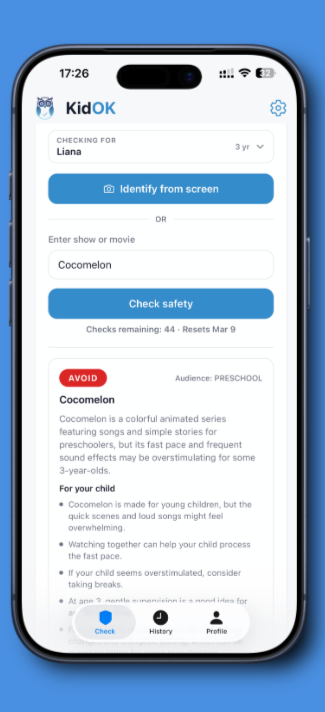
KidOK provides detailed content ratings for shows, movies, and online videos, including overstimulation risk factors. Parents can check before playtime and make decisions based on fit, not guesswork.
How KidOK Helps
At KidOK, we understand that every child is different. Some children do well with Cocomelon in small doses, while others become dysregulated after a single episode. That variation is exactly why we built KidOK.
KidOK provides detailed content ratings for shows, movies, YouTube videos, and games. Parents can review overstimulation risk, age-appropriateness, and practical parental-control guidance in one place. We also surface alternatives for families seeking calmer options based on child sensitivity and daily routine needs. Parents using KidOK often report smoother transitions and less bedtime conflict when they pre-screen titles and plan calmer follow-up activities.
Download KidOK today and check any title before your child watches. Download on theApp StoreGet it onGoogle Play
Conclusion
Cocomelon can be overstimulating for some children because of rapid pacing, high visual intensity, and dense audio layering. For other children, it may be manageable in short, structured sessions. The best strategy is to observe your child, track patterns, and adjust duration, timing, and content type based on real responses. Screen time does not need to be all or nothing. With awareness, moderation, and better content choices, families can use media in ways that protect regulation, sleep, and learning.
This guide is based on research and expert opinion and is not medical diagnosis. Consult your pediatrician for personalized guidance.